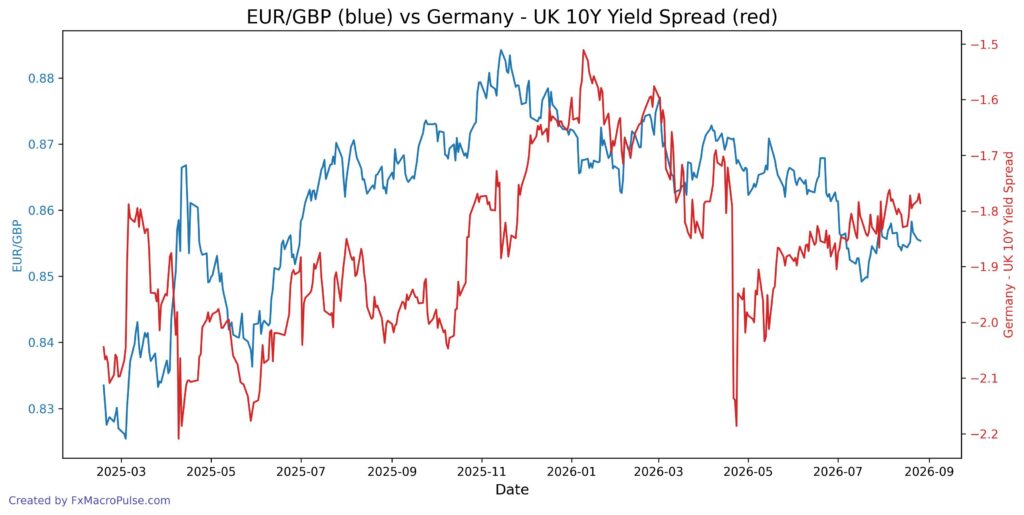
Macro Analysis
On the daily timeframe, EUR/GBP has been trading in a relatively tight range. After reaching a local high near 0.8583 on August 20, the pair drifted lower to around 0.8554 by August 26. That move shows a clear lack of follow-through buying above 0.858. Price is now sitting below that short-term resistance, with support visible around 0.8540–0.8535 from the August 12–13 lows. On a weekly view, the pair remains inside the broader 0.8500–0.8700 range, but the recent weekly candles tell a story of hesitation rather than strong direction.
The MacroFlow Index has been flat at 98.26 since August 17, even as EUR/GBP pushed higher to 0.8583 and then pulled back. This flatness is important. Because the index is positively correlated with the Germany/UK 10Y yield spread and the Germany/UK stock ratio, a stable MacroFlow reading means those two macro inputs are not providing fresh momentum. When the pair moves up or down while the MacroFlow Index stays still, we see divergence. That divergence is visible in the last two weeks: price tried to rally, but the macro fundamentals behind the index did not confirm the move.
Looking further back on the daily chart, this is not the first recent divergence. In mid-July, EUR/GBP fell to 0.8498 while MacroFlow moved from 98.19 to 98.29. The pair then reversed higher, but MacroFlow continued to wander sideways. This weak relationship lines up with the low historical correlation of 0.17. For Forex traders, the key takeaway is that MacroFlow is not currently leading EUR/GBP. The pair is more driven by short-term technical positioning and cross-flow dynamics than by the German/UK yield spread or stock ratio momentum.
In simple terms, the recent price action shows a pair stuck in a short-term range, with MacroFlow flattening out at the same time. Price diverged above 0.858 on August 20, but it failed to hold, and MacroFlow gave no fundamental push. Until the MacroFlow Index starts moving with conviction, daily and weekly traders should expect range conditions to remain the dominant tone.
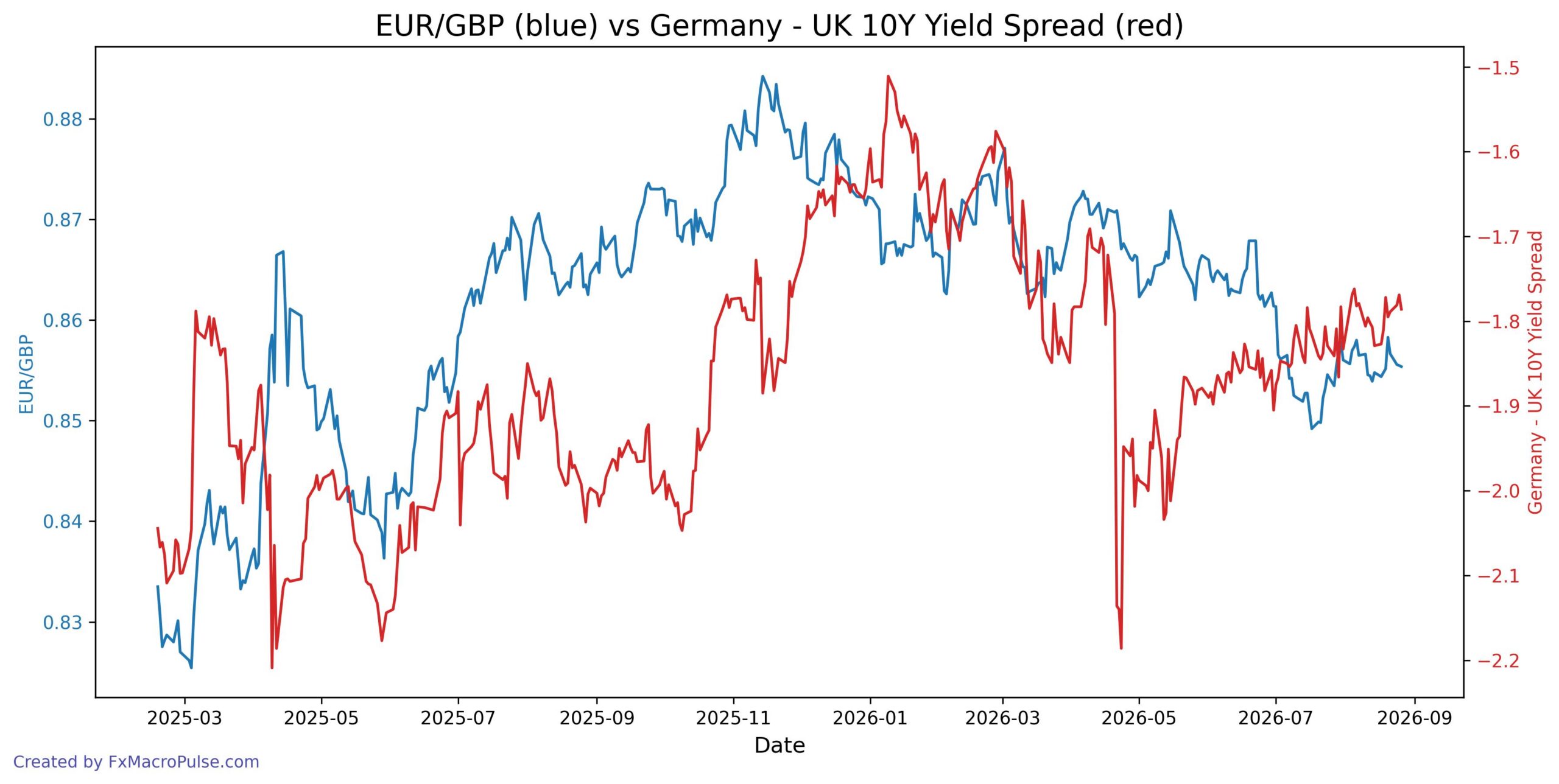
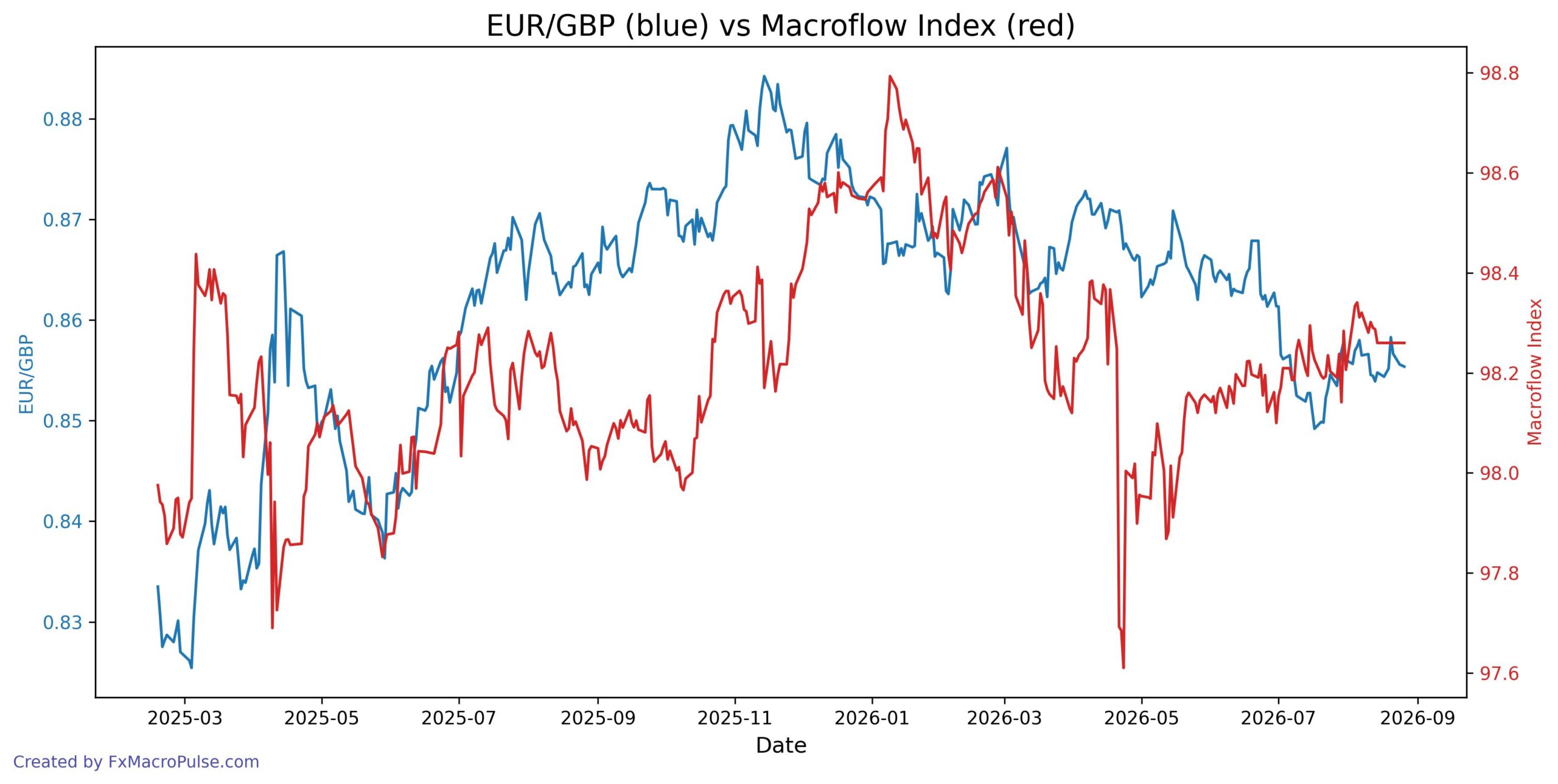
[The MacroFlow Index is a proprietary index created to track the pair’s fundamentals, and tracks the following: Germany/UK 10Y Gov. Yield Spread, Germany/UK Stocks Index Ratio.]
COT Analysis
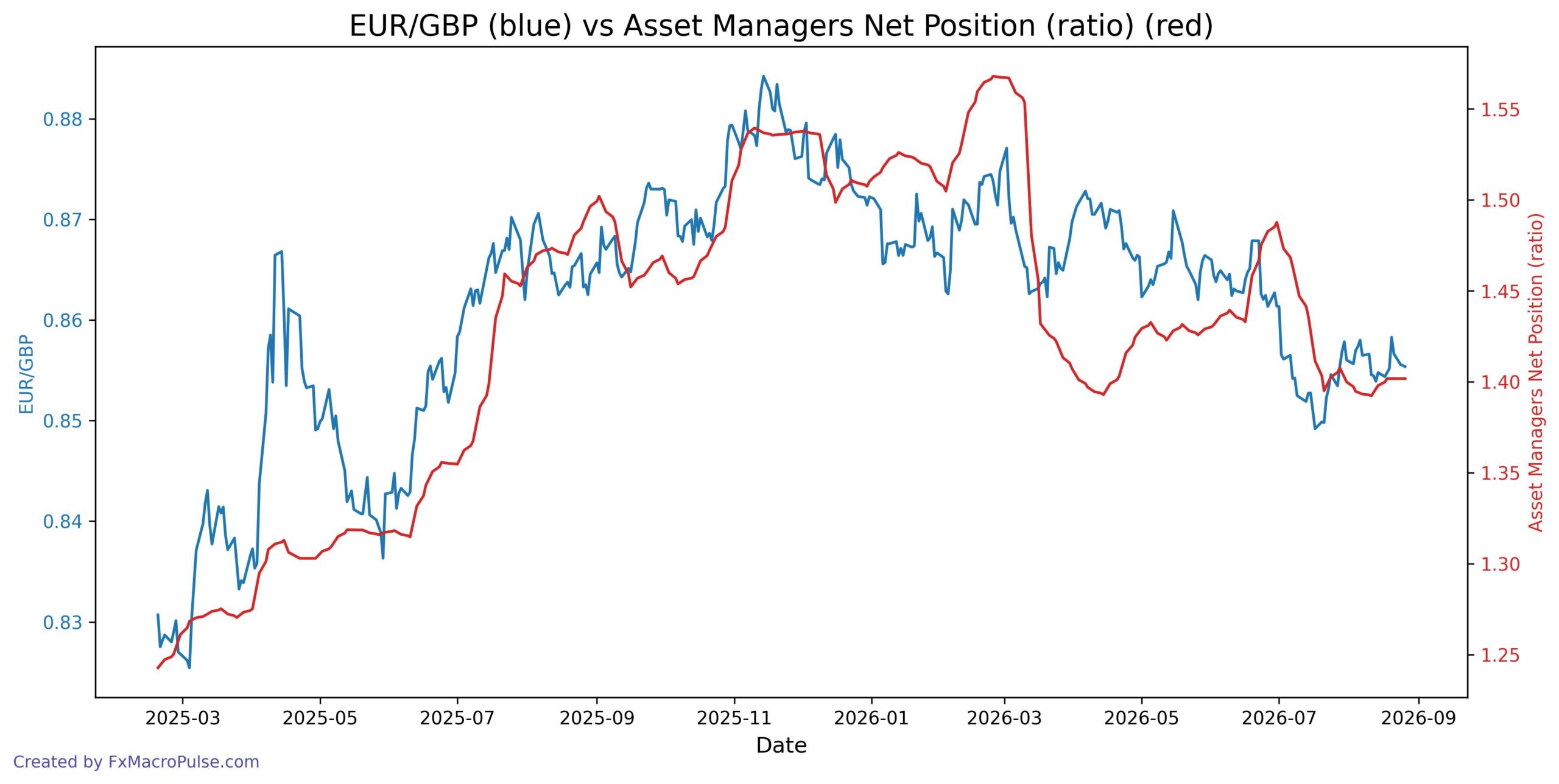
On the daily chart, EUR/GBP rebounded from 0.8492 in mid-July to 0.8583 by 20 August, but the COT asset-manager ratio kept falling from 1.483 to 1.392 over the same stretch, a clear bearish divergence between price and money flow. Since mid-August, the ratio flattened near 1.40177 while price pulled back to 0.8554, so the latest bounce lacks strong positioning support. On the weekly timeframe, EUR/GBP stays below the 0.866–0.868 supply zone, and the negative COT correlation suggests the pair’s direction depends more on BoE/ECB policy expectations than on speculative euro buying.
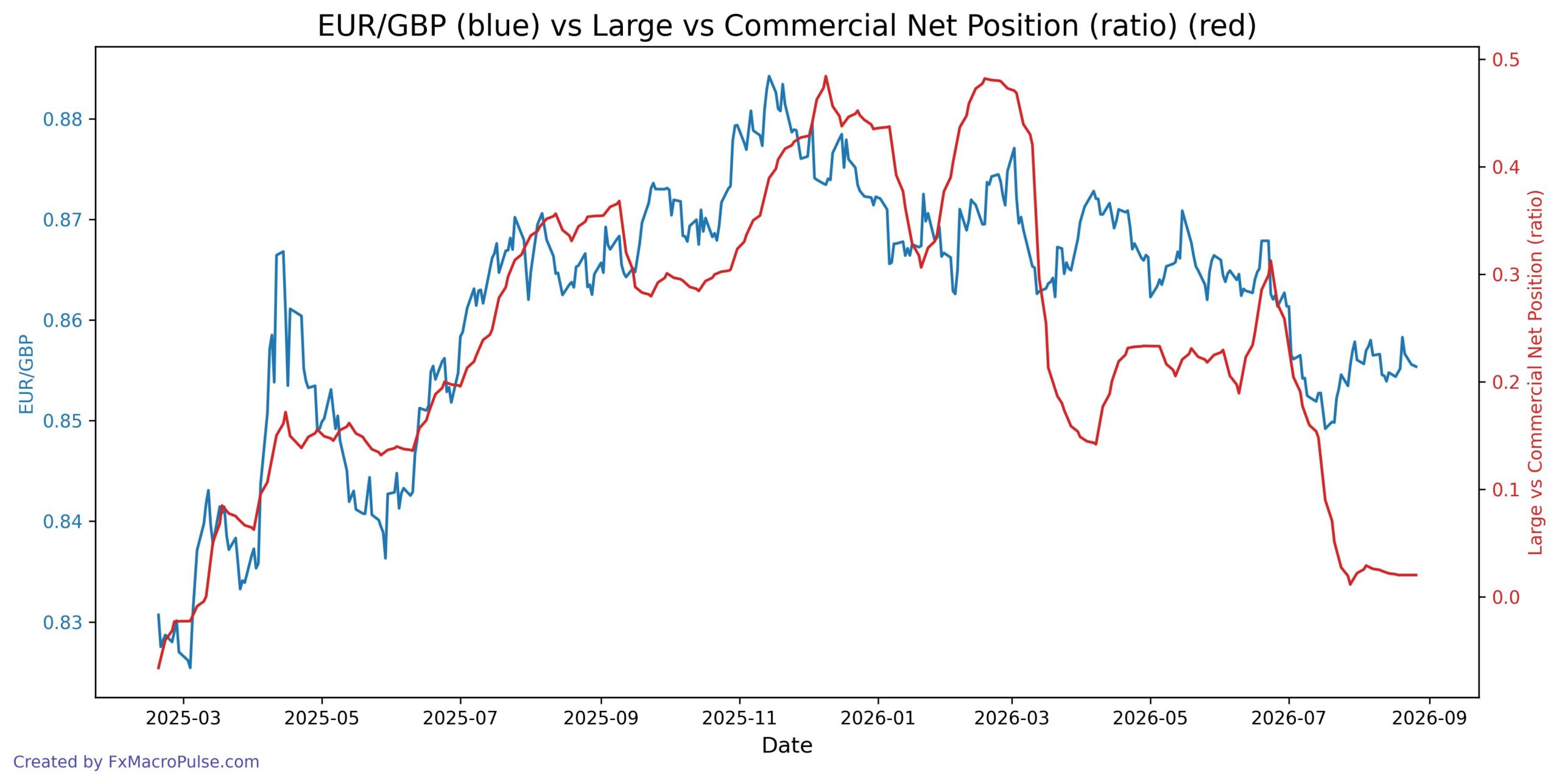
EUR/GBP shows a mild divergence on the daily chart: price recovered from the late-July low near 0.849 to trade around 0.856-0.858, while the Large vs Commercial Net Position ratio remains pinned near zero after a sharp decline. This suggests large speculators have unwound their long euro positioning even as spot stabilizes, so the recent bounce lacks strong COT confirmation. On higher timeframes, the pair stays capped below the 0.862-0.865 resistance zone, and the flat money flow reading points to cautious positioning ahead of BoE and ECB policy signals. Traders should watch for either a breakout above that resistance with rising COT, or a pullback if price continues diverging from sentiment.
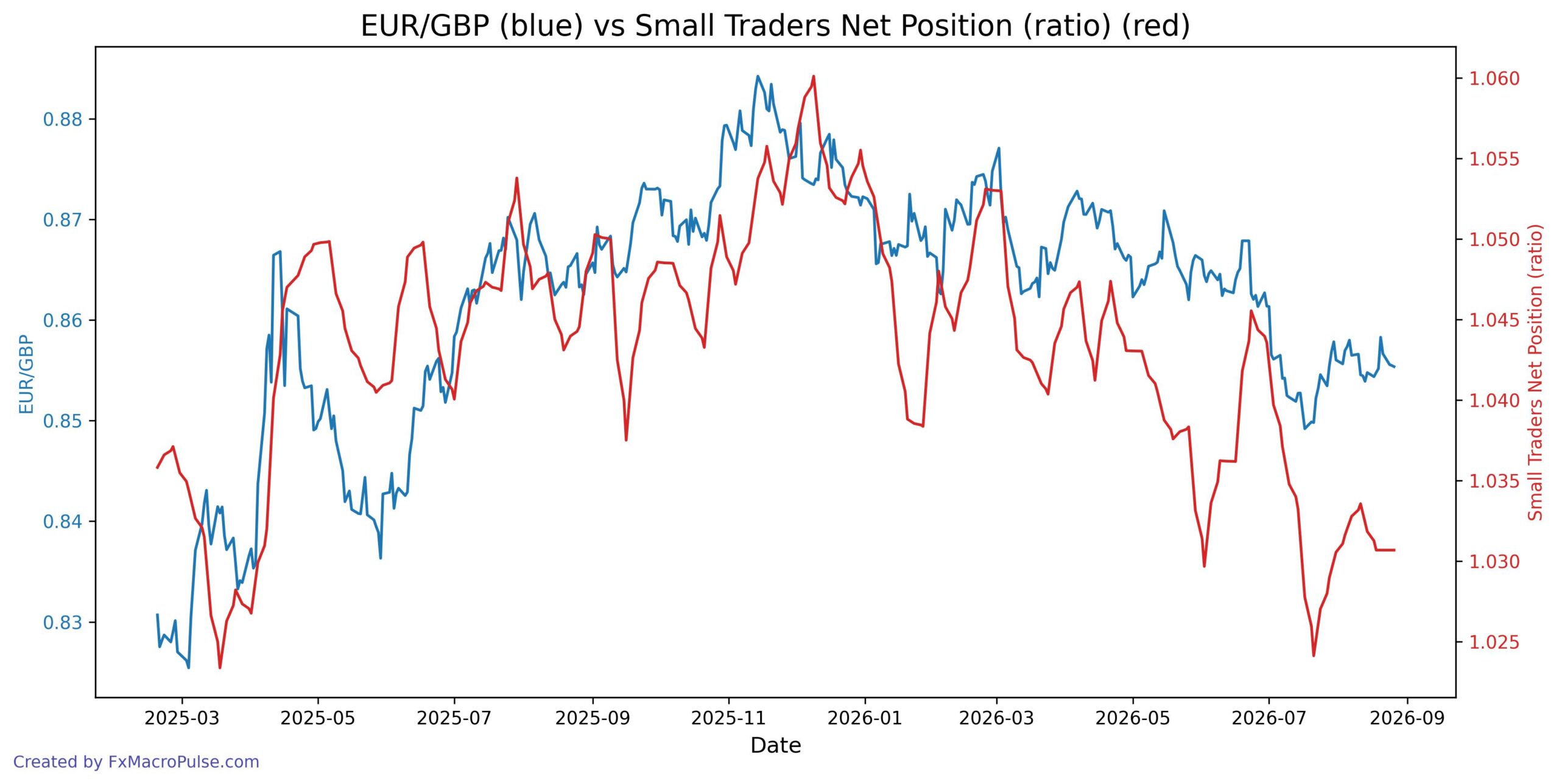
EUR/GBP has recovered from the 0.8490 area in mid-July to trade near 0.8550-0.8580, and the Small Traders Net Position ratio bottomed at roughly the same time before ticking higher. This creates a convergence between the price bounce and small speculators’ sentiment turning less bearish, which supports the recent daily uptrend. However, the pair remains stuck in a wider range, and with the COT ratio flattening near 1.030-1.033, traders should watch for a break above 0.8580 or a rollover below 0.8540 to signal the next meaningful move.
News and Geopolitics
Geopolitical currents are tilting the scales against the euro, keeping the pair’s bearish bias intact. The Eurozone’s heavier reliance on energy imports leaves it more exposed to supply shocks, while simmering US-EU trade friction weighs more on the single currency than on sterling. At the same time, the improving momentum in UK-EU relations offers a modest floor for the pound, although fiscal risks in France inject significant uncertainty into the outlook. These crosscurrents suggest the downside remains the path of least resistance, though the macro backdrop is far from one-directional.